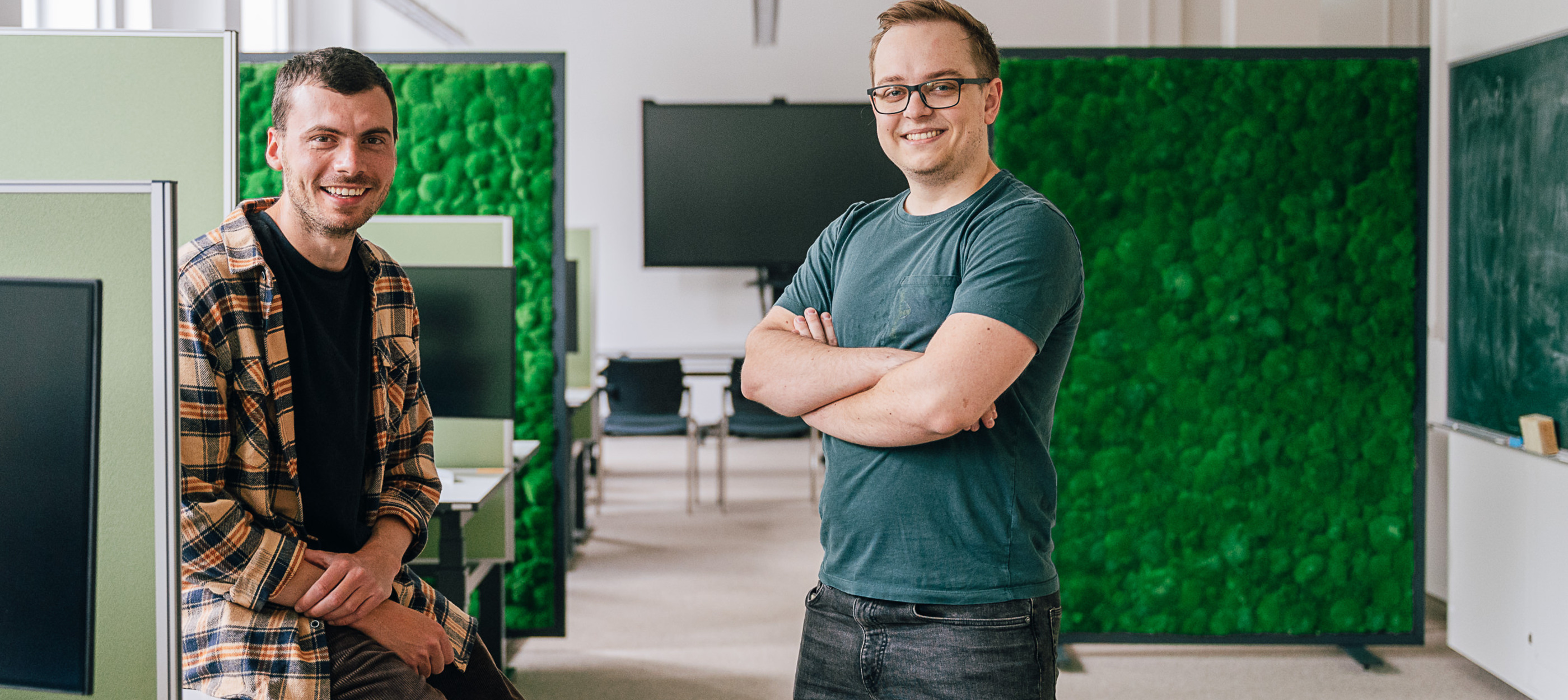

Weronika Mazur and Michael Bussmann have landed well at the CASUS science institute.
A home for science, research and study
For today's issues and tomorrow's challenges
Besides an internationally oriented university, this European city is also home to other research institutions. The German-Polish CASUS Institute here in 2019. It investigates complex systems, from climate to space, from mobility in metropolises to human metabolism. To this end, it develops enormously complex and powerful digital tools – a fascinating topic for our future and an important driver of innovation in our city.
With a history spanning approximately 200 years, the Senckenberg Society for Natural Research a considerably longer tradition. Its research and presentations focus on topics such as biodiversity, systematics, and the ecology of flora and fauna. Other renowned research institutions include the Fraunhofer Society, which operates a "Cybersecurity Learning Lab" in collaboration with the Zittau/Görlitz University of Applied Sciences, and the Interdisciplinary Center for Ecological and Revitalizing Urban Transformation, a joint initiative of the Leibniz Institute and the Technical University of Dresden.
German Center for Astrophysics: From Lusatia to the Stars
In autumn 2022, the decision was made to establish a new national research center with international reach in Görlitz. The German Center for Astrophysics (DZA) won the competitive bidding process. The program is groundbreaking: a center for digitization that will consolidate data streams from astronomical observatories around the globe, and a center for cutting-edge technologies that will collaborate closely with industry and existing technology centers in Saxony and worldwide.
The list of scientific and research institutions that have chosen Görlitz as their location is constantly growing. Discover the future "made in Görlitz" here: Visit

HiLusatia! Recognizing challenges and utilizing potential
Welcome to a network with a very special name – and with special ambitions! Together with as many committed partners as possible, we want to tackle the challenges of demographic and structural change in the region: with initiatives and concepts, with sound judgment and passion!
The aim is to specifically increase the attractiveness of research and teaching, as well as to support and optimize working and living environments in Lusatia. To achieve this, we are focusing on excellence, international and regional talent, funding, knowledge transfer, and internationalization.
Because here – in the heart of Europe – is the right place for it, and there is enormous potential for it.
[To the club]
Zittau/Görlitz University of Applied Sciences: Studying in the border region of three countries
At the two campuses in Zittau and Görlitz, the motto "Studying Without Borders" is put into practice and lived by around 3,000 students at Zittau/Görlitz University of Applied Sciences. Here, in the border region of Germany, Poland, and the Czech Republic, practical relevance, academic support, and efficiency are the focus of the studies. This is ensured by over 110 professors and excellent teaching conditions in an international context, from which international students also benefit. Exciting exchange and research programs with universities both in Germany and abroad, the location in a scenic region, and a diverse range of cultural, leisure, and social activities make studying and living here attractive across national borders.
Zittau/Görlitz University of Applied Sciences

Paul Glaser
Research creates perspectives: Stella Vješnica (DZA)
Stella Vješnica is an astrophysicist at the German Centre for Astrophysics (DZA) in Görlitz, specializing in imaging sensors. Her work focuses on the characterization of detector systems in the optical and near-infrared ranges for astronomy. She also contributes to the development of laboratory infrastructure and research activities that will inform future astronomical instruments...
Read moreHannes Zimmermann
Research creates perspectives: Lars Haupt (DZA)
His favorite book is titled "The Man Who Loved Numbers." Even though his Erdős number is very likely infinite, and there is therefore no known co-authorship path to Paul Erdős, Dr. Lars Haupt nevertheless shares a love of numbers. This love led him, by a circuitous route, to the German Center for Astrophysics in Görlitz, where he currently works in the Data Department...
Read morePaul Glaser
Research creates perspectives: Günther Hasinger (DZA)
Prof. Dr. Günther Hasinger is the Scientific Director of the German Center for Astrophysics (DZA). Under his leadership, a team of leading scientists from Germany won the competition “Knowledge Creates Perspectives for the Region.” Together with them, he is building the large-scale research center for astrophysics, technology development, and data science in Lusatia...
Read moreDLR
Research creates perspectives: Syafinah Fong (DLR)
Syafinah is a doctoral candidate at the DLR Institute for Low-CO₂ Industrial Processes. The Malaysian native has been working in Zittau in the field of green steel production since 2023.
Read moreAileen Baumgärtner
Research creates perspectives: Arash Massoudi (HSZG)
Professor Dr. Arash Massoudi is a professor of engineering mathematics at the Faculty of Natural and Environmental Sciences at Zittau/Görlitz University of Applied Sciences. In this interview, the Iranian-born professor talks about his passion for science, his research focus, and what he particularly likes about the Zittau region.
Read moreAileen Baumgärtner
Research creates perspectives: Nikolai Belov (HSZG)
Dr. Nikolay Belov has been a research associate at Zittau/Görlitz University of Applied Sciences since 2025, working in the SCO-TTi team under the direction of Prof. Dr. Sophia Keil. The physicist received his doctorate from the Max Planck Institute for Nuclear Physics in Heidelberg and subsequently worked for several years as a developer, researcher, and project manager at Fraunhofer IVI, including on the European MAGPIE project and in the B...
Read moreMaria Lisicka
Research creates perspectives: Christiane Ritz (Senckenberg, IHI)
Professor Dr. Christiane Ritz has been a leading figure in botanical research at the Senckenberg Museum of Natural History in Görlitz for many years. She heads the Botany Department there and is an honorary professor at the International Institute of Science (IHI) Zittau, affiliated with the TU Dresden. Previously, she studied and conducted research in Dresden, Jena, and Giessen. What began as a curatorial position became a true calling. In this interview, she tells her story...
Read moreMaria Lisicka
Research creates perspectives: Karsten Wesche (Senckenberg)
Karsten Wesche has a unique perspective on nature and biodiversity. His work takes him from Central Europe to Mongolia and China. In this interview, he explains what fascinates him about biodiversity, why Görlitz has become his home, and the importance of international projects for his work.
Read moreMaria Lisicka
Research creates perspectives: Anton Potapov (Senckenberg, IHI)
For Prof. Dr. Anton Potapov, the path leads from Moscow to Görlitz. At the Senckenberg Museum of Natural History in Görlitz, he will head the Department of Soil Zoology and simultaneously serve as a jointly appointed professor at the International Institute of Higher Education (IHI) Zittau of the TU Dresden. The position is a perfect fit for his research profile. In this interview, he explains why this move is so beneficial for him and his colleagues...
Read moreMaria Lisicka
Research creates perspectives: Ana Berenice Garcia-Andrade (CASUS)
Dr. Ana Berenice Garcia-Andrade, or Bere for short, has been working at the Center for Advanced Systems Understanding (CASUS) in Görlitz since 2023. The biologist studied in Morelia in the Mexican highlands and earned her doctorate in Xalapa on the Mexican Atlantic coast. At CASUS, she researches how the structure of river systems is related to the diversity of fish species in the rivers.
Read moreMaria Lisicka
Research creates perspectives: Damar Wicaksono (CASUS)
After many years in Switzerland, Damar Wicaksono moved to Görlitz in 2021 to conduct research at the Center for Advanced Systems Understanding (CASUS). He is currently working on new methods to better assess the safety of potential repositories for radioactive waste. He comes from Indonesia, where he completed his bachelor's degree in the university city of Yogyakarta. This was followed by a master's degree...
Read moreFrom student to professor: A career path in her hometown
Prof. Dr.-Ing. Anna Prenzel is a professor of Applied Computer Science at Zittau/Görlitz University of Applied Sciences. In this interview, the Görlitz native talks about her connection to HSZG, her enthusiasm for knowledge transfer, and her love for her hometown.
Read moreResearch and life in Görlitz
Tim Callow and Bartosz Brzoza came to Görlitz from Great Britain and Poland to conduct research at the Center for Advanced Systems Understanding (CASUS). In this interview, the two scientists explain how they came to Görlitz and what they appreciate about working and living in this European city.
Read more